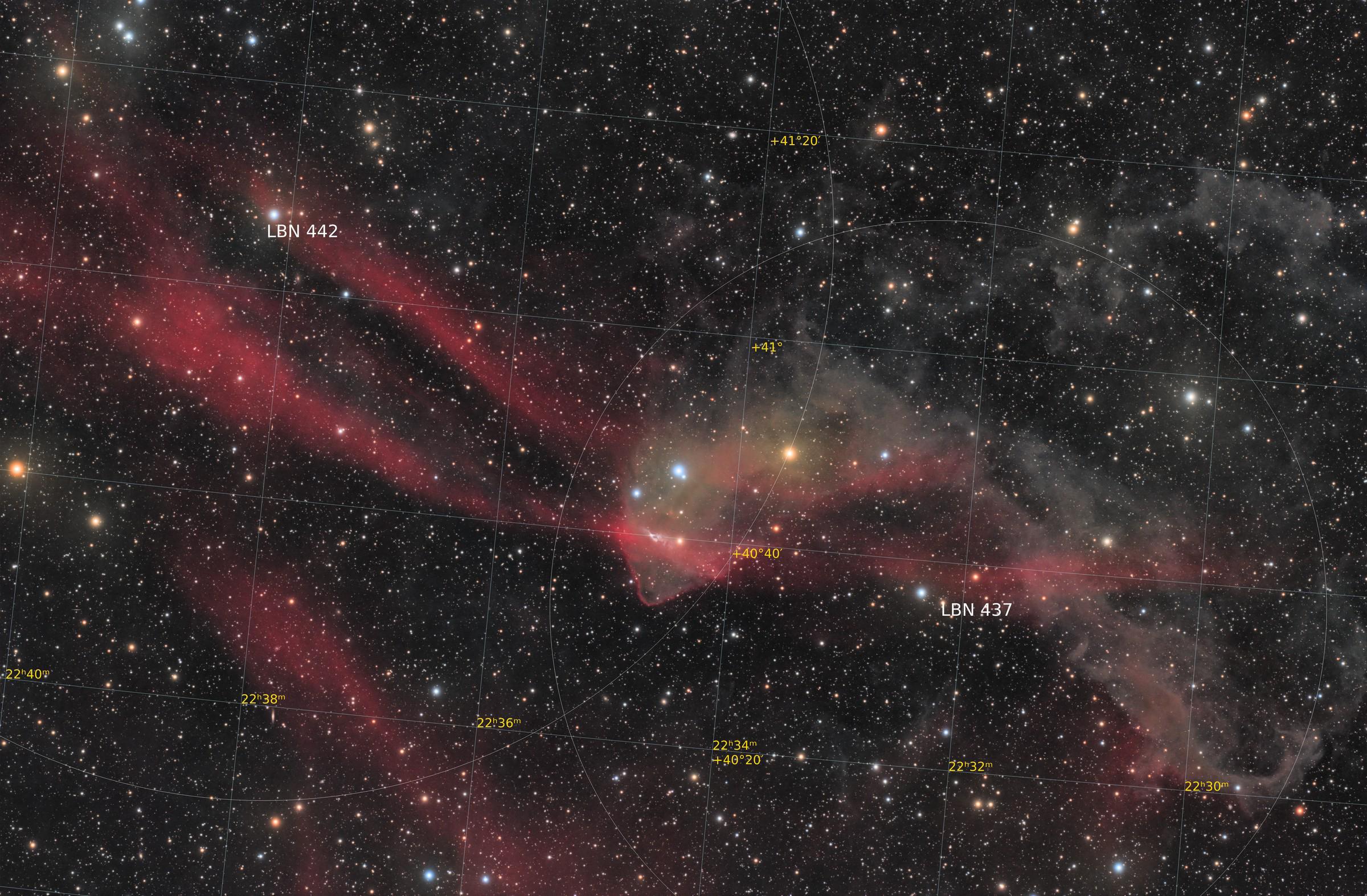
Sh2-126 – the Gecko in Lacerta
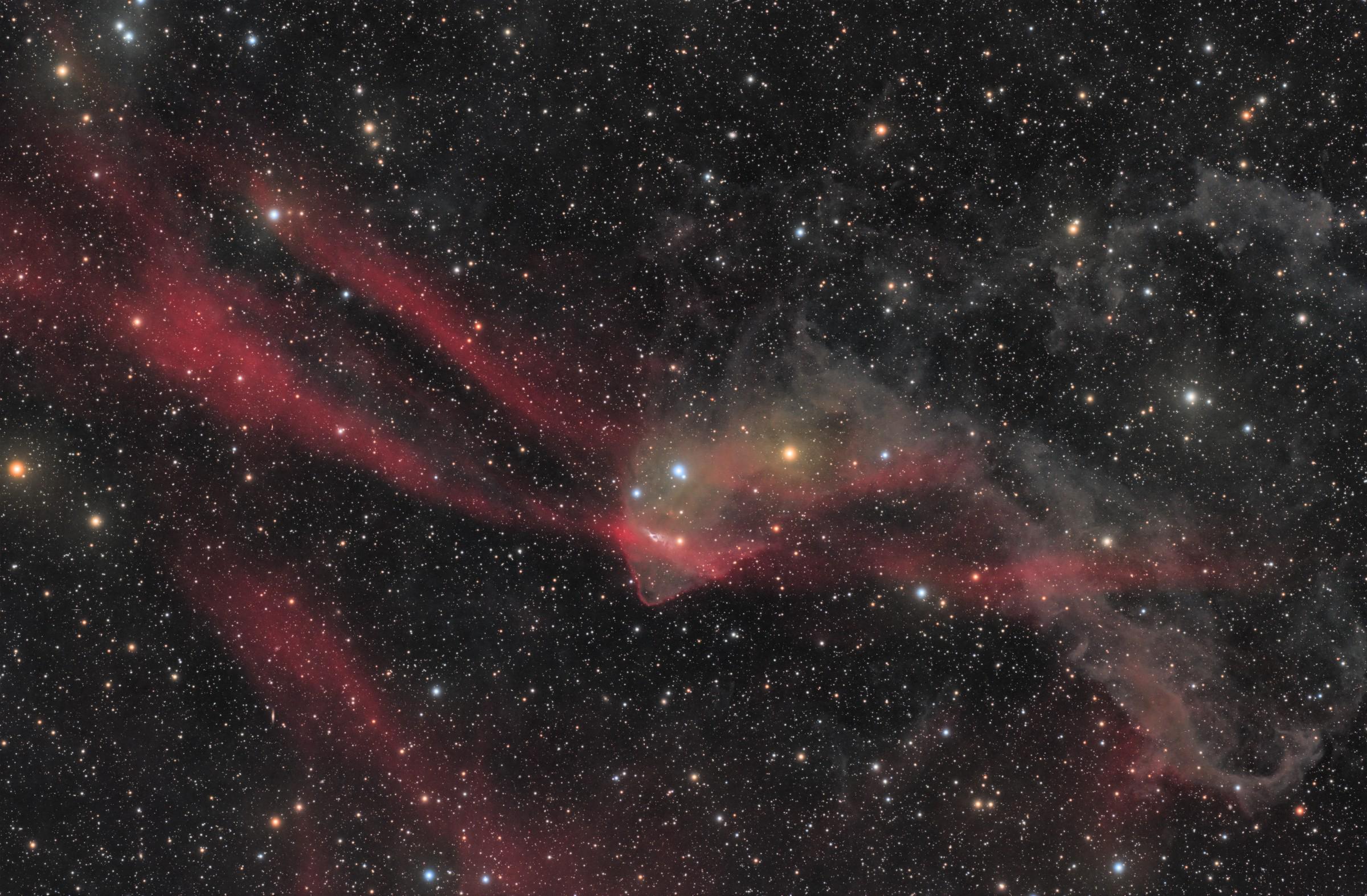
Tucked away in the small constellation of Lacerta, the Lizard, lies a sprawling cloud of hydrogen listed as number 126 in Stewart Sharpless’s catalogue. Its glow is powered by 10 Lacertae, a hot, bluish O-type star belonging to the young stellar group Lacerta OB1. The star’s energetic ultraviolet light excites the surrounding gas, which in turn shines in the characteristic red of hydrogen. Measurements disagree on how far away the region is; most estimates fall somewhere between roughly 1,200 and 1,800 light-years. The nebula cannot be seen through the eyepiece – only long exposures bring out its structure. The shape at the head of the filaments resembles a gecko, a fitting match for its host constellation. Beyond the red bands, grey veils of dust and dark clouds absorb the light from behind.
Acquisition: Askar 80 PHQ (600 mm, f/7.5), ATR2600M (3.76 µm, 1.29″/px), Antlia V-Pro LRGB + Ha. 120 s subs, gain 100, offset 150, −5 °C. L 4:14 h · R 3:40 h · G 4:04 h · B 3:52 h · Ha 18:30 h, total 34:20 h (697 frames) from ten nights in September 2026. Mean FWHM 1.88″, sky brightness 21.18 mag/arcsec².
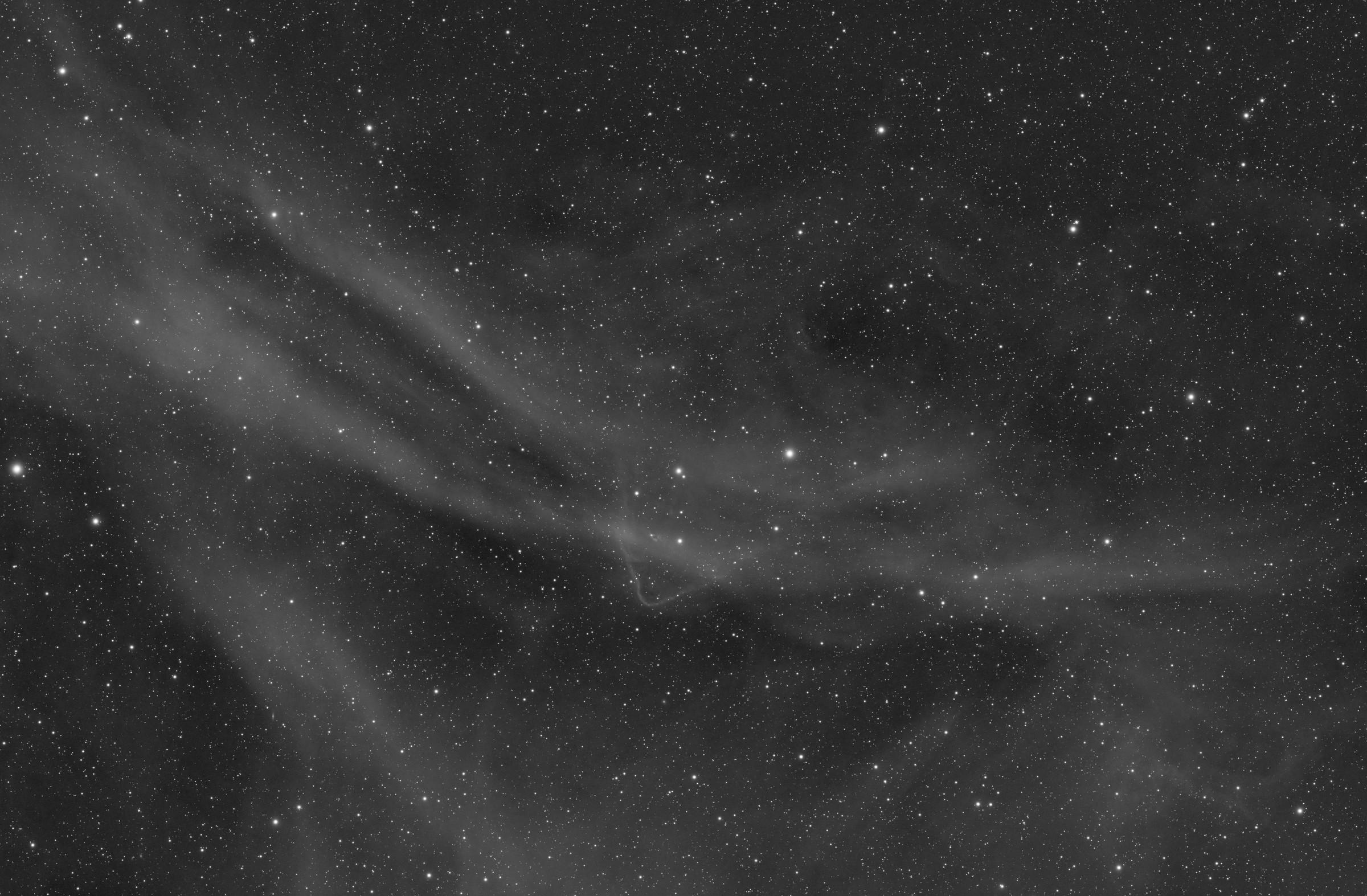
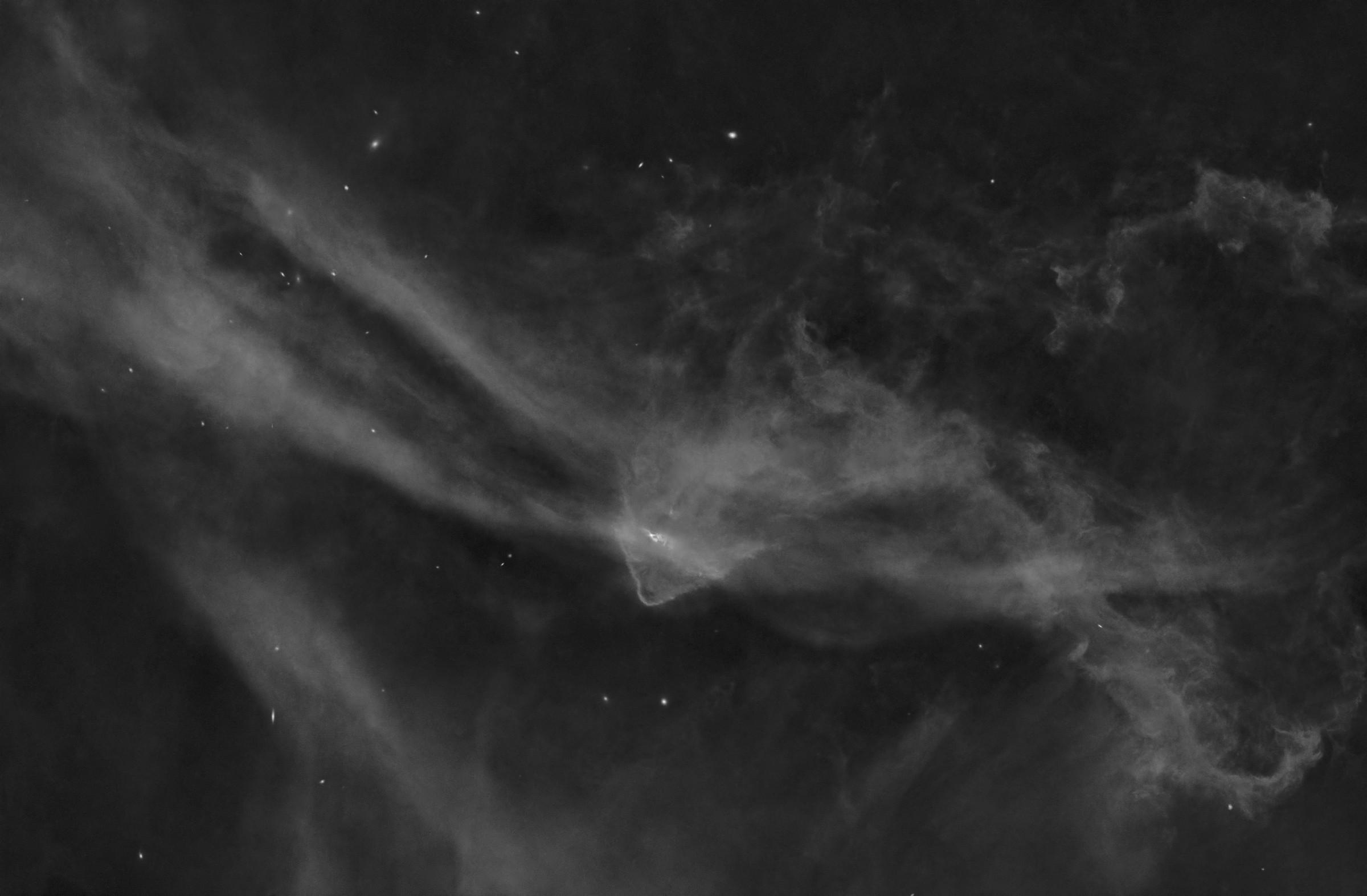
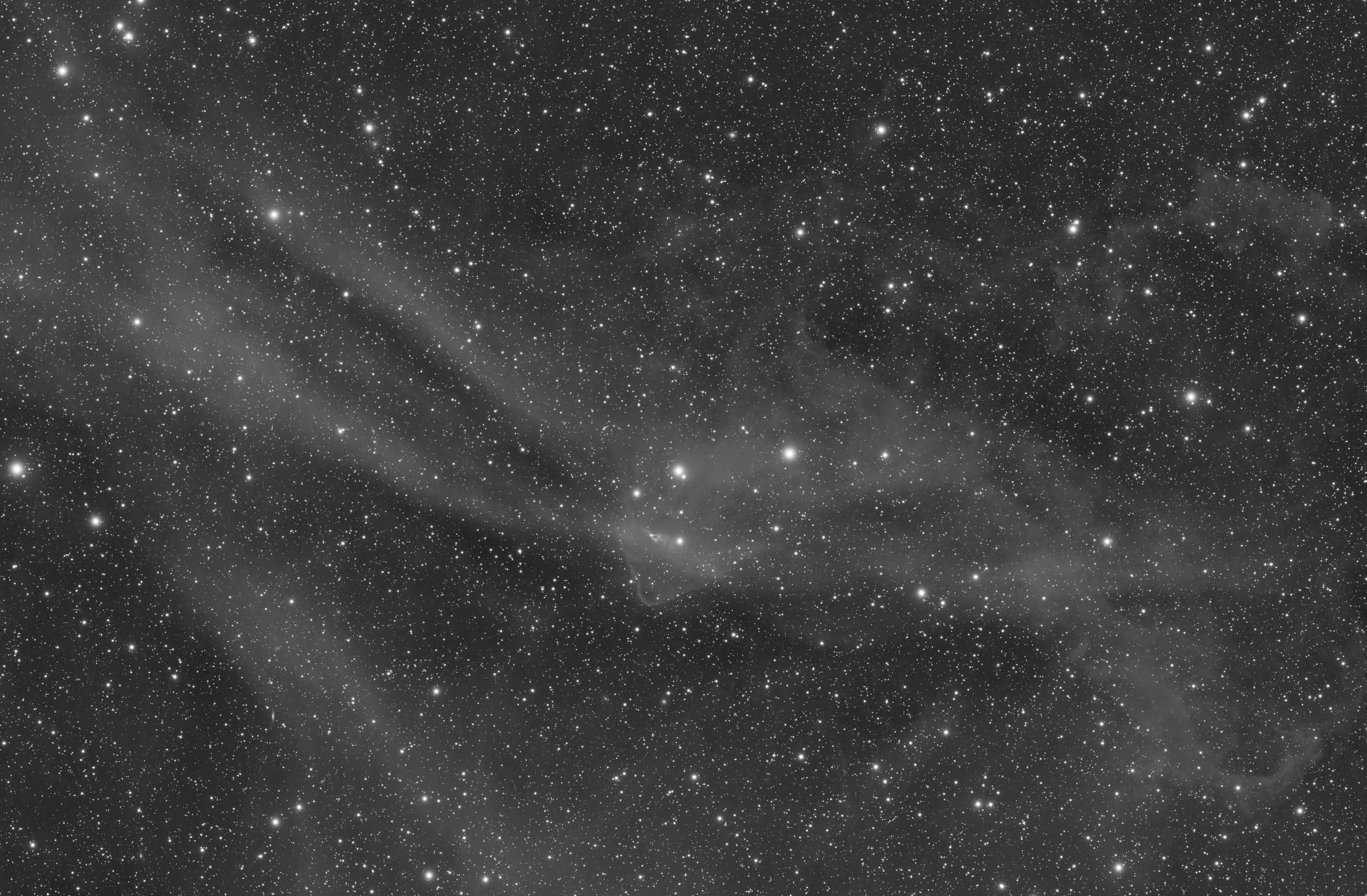
Processing (PixInsight 1.9.5): Pre-processing with WBPP, followed by GradientCorrection, colour calibration with SPCC, and BlurXTerminator and NoiseXTerminator on the linear data. The Ha signal was cleaned of stellar continuum and added to the red channel; a combined luminance was also built from L and Ha. Stretched with GHS, stars separated with StarXTerminator, and contrast and local structure (LHE) brought out in the starless image. Luminance and colour levels were matched before LRGBCombination. Finally, stars were reduced with MorphologicalTransformation and blended back in using a screen blend.
Processing
Workflow HaLRGB workflowVariant Ha per Pixelmath
| Step | Values |
|---|---|
| 4Colour image and colour calibration | 2.784 Sterne; R/G Steigung 0,916, σ 0,029; B/G Steigung 1,344, σ 0,058; White Balance Factors 1,000 / 0,787 / 0,710 (Grün und Blau relativ zu hell – kürzere Rot-Integration, höhere Grünempfindlichkeit des Sensors) |
| 7Blending Ha into the red channel | q = 0,14 (Antlia V-Pro R, nach SPCC) |
| 9Stretching | ‘HaRGB: Hintergrund-Median ca. 1,2·10⁻⁴; Grundstreckung D = 4, b = 8, dann D ≈ 2–3, Schwarzpunkt, weiterer Zyklus. L_neu: D = 4 / b = 8, Schwarzpunkt, dann D = 1,66 / b = 3,07 mit SP 0,020 und LP 0,018, kleiner Schwarzpunkt’ |
| 11Processing the starless images | ‘SCNR Amount 0,5–0,7; S-Kurve 0,08 → 0,06 und 0,85 → 0,93; Kanal S 0,11 → 0,12, 0,47 → 0,52, 0,75 → 0,85. LHE Kernel 96 / CL 1,5 / Amount 0,30 und Kernel 24 / CL 1,5 / Amount 0,15. Range Mask Lower limit 0,15, Fuzziness 0,15, Smoothness 8’ |
| 12Combining and background | Lightness 0,35, Saturation 0,30–0,35 (mit 0,5 gingen graue Staubstrukturen ohne Messstelle verloren). Hintergrund 0,19 → 0,16, 0,40 → 0,40. Neutralität R 0,104 / G 0,101 / B 0,106 – der warme Eindruck war Simultankontrast |
| 13Processing the stars | MorphologicalTransformation Amount 0,60, Selection 0,25, 5×5 kreisförmig |
| 14Recombining the stars | s = 1,0 – Werte darunter machten das Bild flacher |